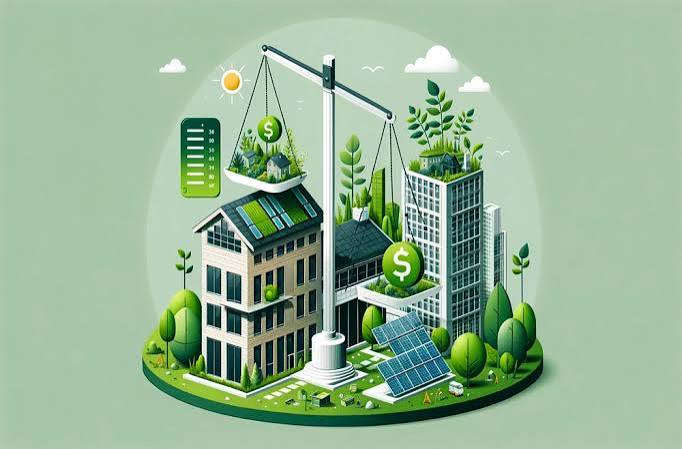
Ask most developers what worries them about going green, and the answer is almost always the same: cost. It's an old fear, and one we hear on nearly every client call, usually before we've even opened the drawings. The research, though, tells a different story, and it has been telling it for over a decade.
What the numbers actually say
A widely cited 2016 review in the journal Energy and Buildings analysed 17 empirical studies on green construction and found that more than 90% of documented cost premiums fell somewhere between -0.4% and 21%, with the bulk clustering far closer to the low end. IFC, a member of the World Bank Group, reports that EDGE-certified buildings a system we work with routinely, typically cost less than 2% extra to build. The World Green Building Council's landmark review of global case studies found design and construction premiums in a similar 0–12.5% range, consistently recovered through lower operating costs.
Design and certification fees
This is usually the smallest line item. Certification consulting, documentation, and rating-system fees (IGBC, GRIHA, LEED, EDGE) add a modest fraction to overall project cost, and a green building consultant brought in at the concept stage, not after drawings are finalized keeps this line lean.
Materials and systems
This is where the real spend sits. Energy-efficient glazing, low-VOC finishes, water-efficient fixtures, and better insulation once carried a heavier premium. As certified materials have scaled across Indian manufacturing, that gap has narrowed considerably.
Where the savings show up
This is the part most calculators skip. The World Green Building Council found certified buildings use 20–40% less energy and water than conventional ones, with homeowners saving 15–20% on utility bills. A 2025 meta-regression published in Smart and Sustainable Built Environment confirmed that green certification premiums hold consistently across global housing markets, while a separate 2024 study in the journal Land found that certified residential properties command a resale premium that doesn't erode over time. Even in commercial real estate, the MSCI Green Annual Property Index 2025 recorded certified offices valued at roughly 46% more per square metre than uncertified equivalents. Add FSI incentives several Indian states now offer, and the total sustainable construction cost frequently comes out ahead within a few years, not decades.
Residential, commercial, or infrastructure: the pattern holds
A green residential society, a bank branch pursuing IGBC Green Interiors, or a manufacturing unit chasing a Green Factory rating all follow the same curve: a small, well-documented premium upfront, offset by savings that begin the day operations start.
The honest answer to "where does the budget go" is: mostly the same places it always went. What's changed is how small that green line item has become, and how well the payback is now documented.
If you're budgeting a project and want a realistic, category-wise breakdown instead of a rough estimate, that's the conversation to have with your green building consultant before drawings are finalized.
References
Chau, K. W., Huo, D. D., & Liusman, E. (2024). Non-institutional factors that contribute to the green building premium. Land, 13(7), 1044. https://doi.org/10.3390/land13071044
Dwaikat, L. N., & Ali, K. N. (2016). Green buildings cost premium: A review of empirical evidence. Energy and Buildings, 110, 396–403. https://doi.org/10.1016/j.enbuild.2015.11.021
International Finance Corporation (IFC), World Bank Group. (2021). EDGE green building certification: India brochure. IFC EDGE Buildings.
MSCI / Green Building Council South Africa. (2025). MSCI Green Annual Property Index 2025.
Wang, J., Lee, C. L., & Han, H. (2025). Green building certification and drivers of green premiums: A meta-regression analysis on global housing market. Smart and Sustainable Built Environment (ahead-of-print). https://doi.org/10.1108/SASBE-11-2024-0472
World Green Building Council. (2013). The business case for green building: A review of the costs and benefits for developers, investors and occupants. WorldGBC.